Last month, the European Union and India concluded over three years of negotiations on a long-awaited deal for a Free Trade Agreement.
This is a key deal to watch as the EU is India’s second-largest trading partner (after the United States), accounting for 11.5% of total Indian trade in 2024. India is the EU’s ninth largest trading partner, accounting for 2.2% of the EU’s total trade in goods in 2023.
“Some call it the mother of all deals. One that would create a market of 2 billion people, accounting for almost a quarter of global GDP.” – European Commission President Ursula von der Leyen
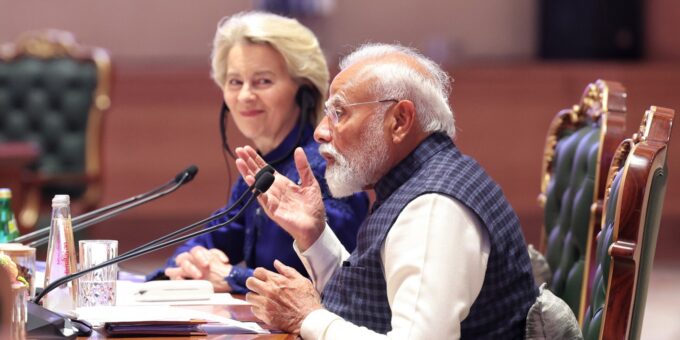
Copyright : India’s Prime Minister Office (2026)
“This will boost investment, form new innovation partnerships and strengthen supply chains at the global level… This is not just a trade agreement, it is a blueprint for shared prosperity.” – Indian Prime Minister Narendra Modi
Across automotive, steel, chemicals, plastics, pharmaceuticals, and agri-food, the emerging EU-India trade agreement has the potential to significantly reshape trade flows between two major industrial powers. Compared to the current highly protectionist baseline, the announcements suggest that the deal marks a clear step forward, opening up key sectors and strengthening bilateral economic ties.
For a trade partnership so significant, our team of experts in Brussels and Delhi will be weighing in with insights as to what this agreement means for key sectors.
For the first part of our series, our experts will explore provisions related to pharmaceuticals.
Haven Hightower, Vice President, FleishmanHillard EU
The measures for pharmaceuticals unlock benefits for patients and manufacturers on both sides of the deal. Through the removal of tariffs, European producers get increased access to Indian markets, while reinforced cooperation measures will strengthen India’s exports of generics and biosimilars to the EU.
Pharmaceutical trade between the EU and India has grown significantly in recent years, rising from $1.5 billion in 2015 to well over $2.5 billion by the early 2020s.
This is due to several factors, including rising demand, improved regulatory cooperation, and pandemic-driven needs. While the EU has looked to decrease reliance on third countries, India’s position as a clear partner for both raw materials and finished products for pharmaceuticals has been reinforced. However, the trade balance in recent years has shifted in India’s favor as its export to the EU exceeds its import.
With this imbalance in mind, a key sticking point for pharmaceuticals throughout the negotiations hinged on the question of Intellectual Property (IP) rights. The EU advocated for stronger IP protection for innovative pharmaceutical products while India wanted to protect, and even enhance, its ability to produce generics and provide affordable medicines globally.
The outcomes of the agreement lean towards EU demands. In exchange for removing tariffs on European exports to India on pharmaceuticals (currently at 11%) and medical devices (27.5%), producers of generics and biosimilars in India will receive boosted exports. However, this comes with the caveat of meeting stricture of EU quality standards and adhering to longer patent protection periods. Time will tell if this helps remove barriers for Indian firms and encourage innovation and higher quality medicines, or if stricter IP will delay generics prices in India and around the world.
Tanya Mitra, Account Director, FleishmanHillard India
The pharmaceutical provisions of the Agreement are expected to enhance market access for Indian pharmaceutical and medical device manufacturers through tariff liberalisation and regulatory alignment. The removal of EU tariffs previously as high as 11%, improves cost competitiveness for Indian exports and opens expanded entry into one of the world’s largest healthcare markets.
Beyond immediate trade gains, the agreement is likely to reshape India’s role within global healthcare supply chains. As exports to the EU continue to outpace imports, improved access is expected to support manufacturing scale expansion, attract investment into production capabilities, and accelerate India’s transition from a volume-based supplier toward higher-value participation in pharmaceutical value chains.
This deepening trade relationship brought IP to the center of negotiations. In India, IP provisions have been viewed through the lens of pharmaceutical access and regulatory sovereignty. Industry groups, including the Indian Pharmaceutical Alliance, see potential for stronger innovation partnerships and improved access to newer therapies under existing TRIPS-aligned frameworks. Public health advocates, however, have raised concerns around possible “TRIPS-plus” measures, such as data exclusivity or patent term extensions, warning that these could affect the affordability of medicines and the sustainability of India’s generics ecosystem. As a result, the discussion has extended into broader national policy debates, including calls for parliamentary scrutiny and safeguards for public health priorities.
The emerging framework reflects a calibrated compromise between expanded market access and regulatory obligations. While improved competitiveness and liberalised access create opportunities for employment generation, MSME participation, and capacity expansion, Indian exporters will also need to meet stricter EU regulatory standards and adapt to evolving IP expectations. The long-term benefits will depend on India’s ability to strengthen compliance infrastructure, invest in quality systems, and move toward innovation-led pharmaceutical growth.
This article is the first part in our series analysing the EU-India FTA. Stay tuned for more insights.
-

Haven is a policy and political outreach specialist who supports clients in health sectors by directing engagement with Brussels stakeholders. Prior to joining FleishmanHillard, she worked as head of office for a Member of the European Parliament on two committees: Environment, Public Health and Food...